
Moon Faces and Illusions
The story behind the poem “Moonburnt”

“Moonburnt
Shine the apple if it’s to be on display. Ideal lighting can be achieved.
They use Elmer’s Glue in cereal commercials instead of milk you know. It’s more agreeable with the hot lights.
Electronics- those control panels are so orderly, but the rat’s nest just behind can shock, literally and figuratively.
Our heroes can stun us with their aberrant behaviors while known ne’er-do-wells often surprise with their humanity.
We found out that time doesn’t exist in the linear framing we perceive.
We decide which is right and which is an illusion.
We contribute to the confusion greatly. Clarity isn’t the goal. Ideally it’s a mastery of deception, not deliverance from it.
The game is rigged because we rig it. We bait that hook daily, and nightly.
Our essence must remain behind a paywall of trust. The truth about us must be released in small data dumps. It has to be managed.
It’s Relational Impressionism: an artistic display designed for beauty to be seen from afar, due to assumption that a closer stance would reveal the errant strokes.
We deceive ourselves and others, and this is the reality we prefer- one with author’s privilege.“
I don’t usually write this sort of fare. I wanted to stretch out though and get artistic that night. Also many months ago, when health was in sufficient quantities, I had an eye on pushing the envelope of writing style. Inspired by the vision of Hunter S. Thomson, I envisioned creating my own ‘modus novus’. Immediately I was convinced to abandon the idea for the moment.
A week or so ago I was sitting around considering the word “Moonburned”, arriving at the concept via 180 degree solar absurdism. I had never written around a word before, but decided to there. The word to me meant being burned out by these ideas of accepted falsehood. These roles we play by night that is. I wanted something real. The pic I chose came from Frank Capra’s “It’s a Wonderful Life”. I couldn’t find it on the web so I played the movie and got a screengrab.
The night referred to in the poem was real. Me, my best friend, and two girls were out later than we should have been in the sticks of a one-horse town. The girl I was matched up with lived in a humble hovel nestled into one of the almond groves.
So the poem, if that’s what it is, is about managed deception. It begins by firing off examples of it in modern society, disguised as seemingly unrelated sentences. We arrive at our part. We all know that the people we first meet, and the people we show to the same are not real. We accept it due to the payoff- the thrill it provides. It’s like a drug.
Relational Impressionism- an accurate analogy. Through fear and addiction to the “new”, we agree to the terms of the human relation game. One with author’s privilege- the ability to fudge the numbers enough to keep things exciting.
Moonburnt continued:
Even the mist was eager to play its part, providing needed cover. Almond groves, and youth chasing the commuting butterflies. She smiled in that grove, and I never looked at the moon the same way again.
The deception continued, and the mist was eager to play a part in it- obfuscation, cover, deception. Commuting butterflies? In the mist? With a moon present? They were not of the lepidopterous variety. This reference was to butterflies of the tummy. Nervousness, cued by the game. Insisted upon by the author’ privilege, pursued by the four youths.
The inclusion of The Moody Blues excerpt happened because I encountered the song and its lyrics while writing the piece and it was consistent with the theme. Kismet. The hodgepodge feeling created by its inclusion works for the new style.
The final contributions to deception came from moi. It wasn’t me that saw the moon in a new way, it was my best friend I was hanging with that night. While walking back to this girl’s house my friend made some sort of positive statement about the moon. I didn’t catch the message of it, and thought nothing of it. I was curious but not enough to ask.
A couple of months later he mentions on the phone to me that he never looked at the moon the same way again after that night. Now this friend of mine was smart, and I looked up to him. But still too cool for school, I did not ask what he meant by it. I’ve since learned to ask- I learn the first time, and as a result I only have to look stupid once- once!
Two decades pass, and the entire time I’m returning to it to roll it around in my mind in an attempt to solve and achieve the same lunar wisdom. Finally I get him on the phone. We exchange cordialities and catch up, but I’m wanting to get to the question. When I did his answer stunned me.
He didn’t glean any higher truths that night after all. There was no mysticism, no chi-charging revelations. The man had seen a face on the moon that night, and subsequent viewings brought the same recognition. He saw “The Man on the Moon”, and has been locked into it ever since. The moon is now a cosmic nightlight with a visage for him. I never even found out if it’s a tolerable one.
I deceived myself for 20 years. Those were my butterflies I was tending to during those decades. Before the collapse of superposition I had writer’s privilege, and the possibilities were tremendous, smart as this guy was. So pareidolia, not cosmic insight this time, but with every new day there’s fresh hope.
“Cold hearted orb
That rules the night
Removes the colours
From our sight
Red is gray and
Yellow white
But we decide
Which is right
And
Which is an Illusion”
- the Moody Blues
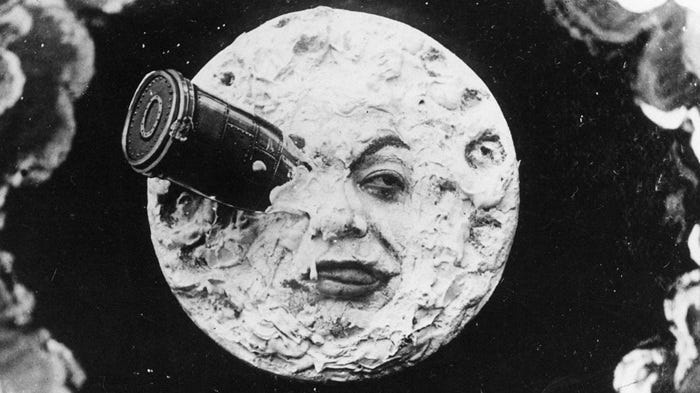
image: still from “A Trip to the Moon” (1902)

You a good writer.